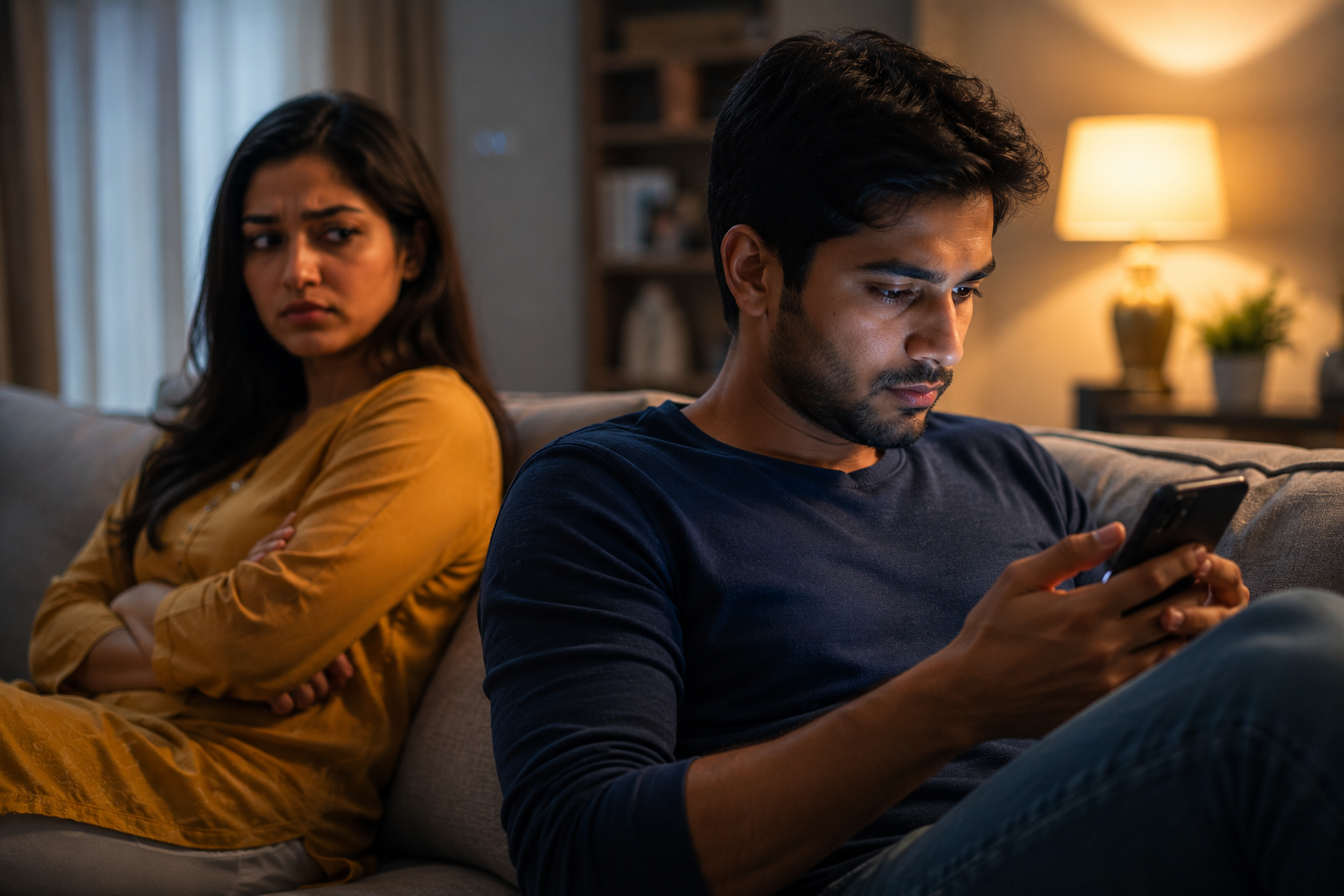
Few things can unsettle a relationship like the feeling that something has changed, but you cannot quite explain what. Your partner seems more distant. Their phone suddenly feels off-limits. Their routine has changed. Conversations that used to feel natural now feel guarded. And then comes the question you may not even want to ask yourself:
“Is my partner cheating on me?”
The difficult part is that there is no single behaviour that can tell you whether someone is cheating. A partner becoming protective of their phone, working longer hours, or becoming emotionally distant can have many explanations. But when several unexplained changes appear together, they may be worth paying attention to.
Infidelity can be physical, emotional or digital, and what counts as cheating can differ from one relationship to another. At its core, however, infidelity usually involves breaking an agreed boundary and hiding something that would matter to your partner.
So, what are the signs of cheating you should actually look for?
12 Signs Your Partner May Be Cheating
1. They have suddenly become very secretive with their phone
Their phone was never a big deal before. Now it is always face down, password-protected, taken everywhere and kept out of your sight. A change in phone behaviour by itself does not prove anything. But new and unexplained secrecy, especially when combined with other changes, can be a reason to ask questions.
2. Their routine has changed without much explanation
They suddenly have more late nights, unexpected meetings, unexplained outings or periods when they are difficult to reach. People's schedules naturally change. The concern is not simply that their routine has changed, but that the change does not seem to make sense and your partner is unwilling to explain it.
3. They seem emotionally distant
You may still be living together, eating together and doing everything you normally do, but something feels different. They share less about their day. They seem less interested in yours. Conversations become practical rather than personal.
Emotional distance can have many causes, but it is one of the changes commonly associated with infidelity.
4. They become unusually defensive when you ask normal questions
A simple question suddenly becomes:
“Why are you questioning me?”
“You are so suspicious.”
“You do not trust me.”
Defensiveness does not mean someone is cheating. But if ordinary questions repeatedly lead to anger, blame or avoidance, it may indicate that something in the relationship needs attention.
5. They are suddenly much more concerned about their appearance
A new interest in clothes, grooming, fitness or appearance is not evidence of an affair. It becomes more meaningful when the change is sudden, unexplained and accompanied by other behavioural changes. There may be a perfectly innocent reason. The point is to notice the overall pattern, not to treat one behaviour as proof.
6. Your partner seems less interested in intimacy
A sudden and unexplained change in your sex life can sometimes accompany infidelity. But this sign is particularly easy to misinterpret. Stress, health, relationship dissatisfaction, exhaustion and many other factors can affect sexual intimacy. The important question is not simply, “Are we having less sex?” It is:
“What has changed between us, and are we able to talk about it openly?”
7. They seem emotionally invested in someone else
This can be harder to recognise than physical cheating. Perhaps there is someone they message constantly, confide in, or seem unusually excited to spend time with. The relationship may not be sexual, but there may be a level of emotional intimacy that has moved outside the boundaries of your relationship.
Emotional infidelity can also damage trust and emotional connection, even when there has been no physical relationship.
8. They start disappearing for unexplained periods
There are suddenly gaps in the day that are difficult to account for. You ask where they were and receive vague answers, changing explanations or very little information. Again, one unexplained evening proves nothing.
Repeated unexplained gaps combined with secrecy are more concerning than a single unusual event.
9. They stop talking about the future with you
Plans that once included both of you seem to disappear. They become less interested in holidays, family plans, shared goals or conversations about the future.
This can happen for many reasons, including relationship dissatisfaction, but when it appears alongside emotional withdrawal and secrecy, it is worth having an honest conversation about where the relationship stands.
10. Their behaviour toward you has changed noticeably
Sometimes the change is not distance but the opposite. They may suddenly become unusually affectionate, unusually generous or unusually attentive. That does not mean affection is suspicious. But if the change feels out of character and comes alongside guilt, secrecy or other unexplained behaviour, it is worth noticing.
11. They accuse you of cheating or suddenly become unusually suspicious of you
Sometimes a partner who is being unfaithful may become suspicious of their own partner. They may start questioning where you were, who you were with or why you took so long to reply.
This can happen for many reasons, including insecurity and relationship anxiety, so it is not evidence of cheating by itself. But a sudden and significant change in suspicion can be another piece of a larger pattern.
12. Your relationship feels fundamentally different
This may be the hardest sign to explain. You know your partner. You know their normal behaviour, their routines and the way they communicate. And something feels different.
Your intuition is not proof that your partner is cheating. But it can be a signal that something in the relationship needs attention. The useful question is not only, “Are they cheating?” It is also:
“Why do I no longer feel secure in this relationship?”
Interested in Learning More?
Share your details and our team will get in touch with you shortly to assist you.
Interested in Learning More?
Share your details and our team will get in touch with you shortly to assist you.
None of These Signs Prove That Your Partner Is Cheating
This is probably the most important thing to remember. Your partner can display several of these behaviours and still not be having an affair. People become distant when they are stressed. They change routines because of work. They become protective of their phones because they want privacy. Their interest in sex can change for dozens of reasons.
Even experts caution that there is no single telltale sign of infidelity. It is usually a pattern of unexplained changes, rather than one isolated behaviour, that deserves attention. So resist the temptation to become a detective.
Checking every message, tracking someone's movements or trying to catch them in a contradiction may give you more information, but it does not necessarily give you clarity about the relationship. Instead, start with a conversation.
What Should You Do If You Suspect Your Partner Is Cheating?
Do not begin with an accusation if you do not have evidence. Instead of:
“I know you are cheating on me.”
try:
“I have noticed that you have been more distant and secretive lately, and it has made me feel that something has changed between us. I want to understand what is happening.”
This keeps the conversation about what you have actually observed and how it is affecting you. Listen to the response.
Does your partner engage with the concern? Are they willing to talk openly? Do their explanations make sense? Most importantly, are both of you willing to address what has changed in the relationship?
Sometimes, the underlying issue is a breakdown in communication. Learning how to communicate better in a relationship can help couples address concerns before they become deeper relationship problems.
HappyBeing's relationship counselling and coaching supports individuals and couples dealing with trust concerns, emotional distance, recurring conflict and post-infidelity challenges.
If Your Partner Has Cheated, Does It Mean the Relationship Is Over?
Not necessarily.
Infidelity can cause deep damage to trust and emotional safety, but it does not automatically mean that a relationship cannot be repaired. Whether a couple can move forward depends on many things: whether the affair has ended, whether the person who cheated takes responsibility, whether both partners are willing to work through what happened, and whether trust can gradually be rebuilt.
Sometimes the relationship can be repaired. Sometimes the healthiest decision is to move on. The important thing is not to make a major decision in the middle of shock, anger or fear. First understand what happened. Then decide what you want to do with that understanding.
For couples who choose to work on the relationship, rebuilding trust, improving communication and restoring emotional connection are important parts of the process. HappyBeing's The Science of Happy Marriage program focuses on these areas as part of building a healthier long-term relationship.
The Bigger Question May Not Be “Is My Partner Cheating?”
When you start noticing changes in your partner, it is natural to search for signs. But sometimes the more important question is what has happened to the relationship itself.
- Have you stopped talking openly?
- Have you become emotionally distant?
- Are there needs that neither of you is expressing?
- Has trust been weakening for some time?
- Has conflict replaced connection?
Infidelity is serious, but so is the loss of emotional connection that can exist long before either person talks about an affair. A relationship does not become healthier simply because you discover the truth.
It becomes healthier when both people are willing to understand what happened, take responsibility for their part, and decide what they want the relationship to become.
Frequently Asked Questions
What are the biggest signs that your partner may be cheating?
Common signs include sudden secrecy around phones and devices, unexplained changes in routine, emotional distance, unusual defensiveness, unexplained periods of unavailability, changes in intimacy and unusual emotional closeness with another person. None of these signs proves infidelity on its own.
Can you tell if your partner is cheating from their phone behaviour?
Sudden secrecy around a phone, such as changing passwords, hiding messages or becoming unusually protective of the device, can be a warning sign. However, phone privacy alone does not prove that someone is cheating.
How do you know if your partner is emotionally cheating?
Emotional cheating may involve developing a secret romantic or emotionally intimate connection with someone outside the relationship, particularly when the connection is hidden and begins to replace emotional closeness with the primary partner.
Should I confront my partner if I think they are cheating?
If you are concerned, an honest conversation is usually more constructive than making an accusation. Explain the changes you have noticed, how they make you feel and ask your partner what is happening.
Can a relationship survive cheating?
Yes. Some relationships recover after infidelity, although rebuilding trust can take considerable time and effort. Accountability, honest communication, ending the affair and a genuine willingness to rebuild the relationship are important parts of recovery.
What should I do if I discover that my partner is cheating?
Give yourself time before making major decisions. Understand what happened, protect your emotional and physical wellbeing, and consider professional relationship support if you are trying to decide whether and how the relationship can be repaired.
At HappyBeing
Trust is one of the foundations of a healthy relationship. When it is shaken, you do not always have to figure out what to do next on your own.
HappyBeing provides relationship counselling and coaching for individuals and couples navigating infidelity, broken trust, emotional distance, recurring conflict and relationship challenges.
Explore Marriage Counselling & Relationship Coaching
Share your details and our team will get in touch with you shortly to assist you.
Interested in Learning More?